

Some discoveries in science are made in the bath, for example Archimedes’ Eureka moment in noticing the displacement of water as a method of measuring an object’s volume, while other discoveries appear in dreams such as Mendeleev’s layout of the periodic table. The discovery I want to share with you herein was less to do with serendipity and more the outcome of three long years of meticulous and technically difficult research.
My collaborators on this project were Dr Gordon Wright, a specialist in how blood flows through the heart, and Dr Olga Korchazhkina, a biophysicist with expertise in measuring the function of isolated animal heart preparations.
At that time in the mid-1990s we were intrigued by reports of sudden deaths due to heart failure in apparently healthy and often young people. Perhaps not dissimilar to the epidemic of ‘covid vaccine’ heart failure we are currently experiencing in athletes and younger people.
I had been following the seminal research of the late and very great Geoffrey Burnstock FRS. It was an honour and a privilege to communicate with the man who discovered that adenosine 5’-triphosphate (ATP) is the major extracellular signalling molecule in biology. We are perhaps all aware of ATP’s role as the major energy currency in biochemical systems but its role in mediating extracellular signalling is arguably of equal importance. It was a travesty that Burnstock died before his brilliance was rewarded with The Nobel Prize. One of Burnstock’s many discoveries was that ATP was a coronary vasodilator. It opened up the vessels of the coronary circulation (this is the heart’s blood flow system) to allow greater perfusion of heart tissue as required. For example, when you are literally running away from a stressful situation. In such circumstances, a greater coronary blood flow provides the heart with the energy it requires to beat more quickly and strongly.
I wondered if aluminium might have a role to play in sudden death due to coronary circulation failure. I decided to test the null hypothesis that the additional presence of aluminium in blood would have no impact upon the dilation of the coronary circulation by ATP. The latter was measured as an increase in coronary flow (change in coronary resistance) in an isolated heart preparation. Dr’s Wright and Korchazhkina were experts in isolated rat heart preparations. It is no trivial task to remove the beating heart from an anaesthetised rat and prepare it for perfusion as an isolated heart. Serious and intricate surgery that provided valuable raw data worthy I would say of animal sacrifice.
If, on a lighter note, I might digress and recall a moment in the pub amongst friends when upon describing the heart research of the day a close friend enquired, ‘but what happens when the rat wakes up?’.
This initial exploratory research proved successful. We found that both ATP and ATP in the presence of aluminium caused an increase in coronary blood flow through vasodilation. However, what was fascinating was that while the ATP effect was reversible the increase in coronary blood flow induced by Al-ATP was not reversible. We published this study in the Journal of Inorganic Biochemistry. Its implications and consequences for healthy human hearts have largely been ignored.
While we had found something interesting (see my paper on its implications for Alzheimer's disease) for us to truly understand the mechanism underlying the effect of aluminium we needed to discover why and how extracellular ATP induced vasodilation in the coronary circulation of the heart. We needed to identify the specific receptor involved in coronary vasodilation induced by extracellular ATP.
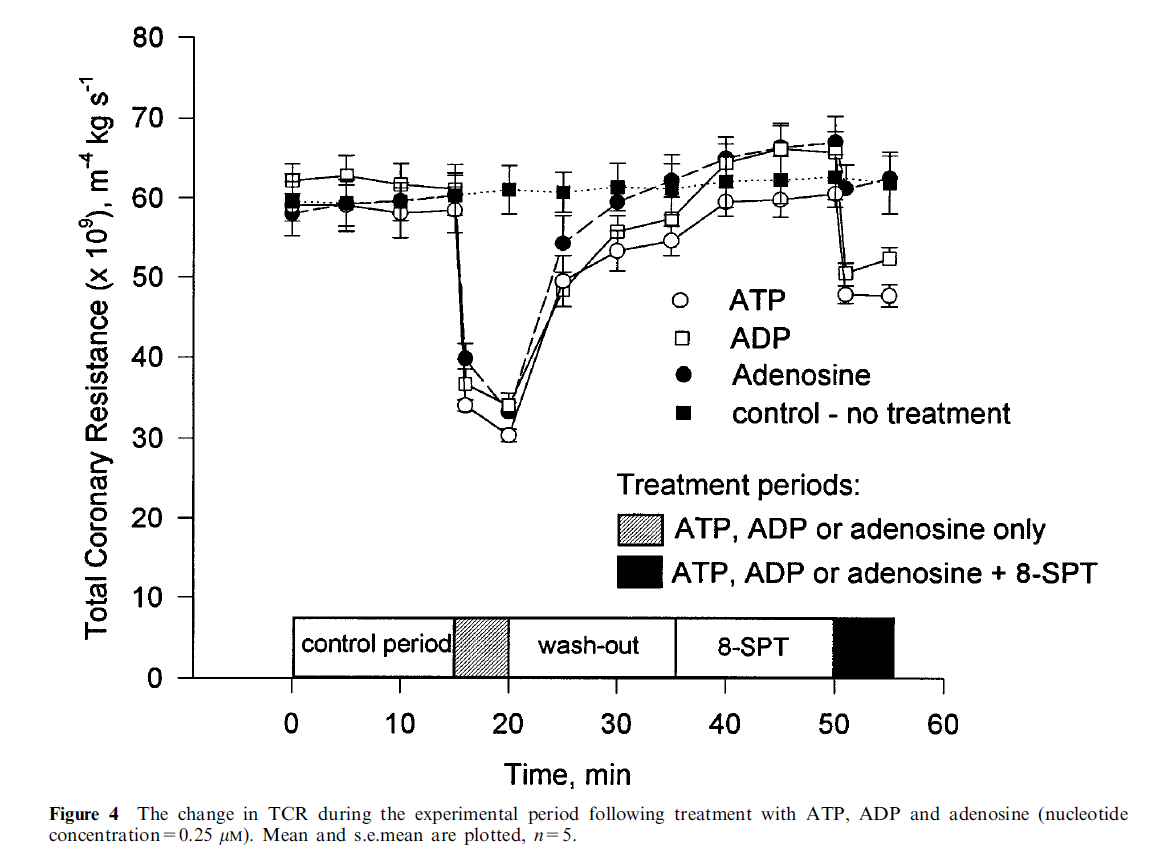
The following research proved to be the piece de resistance of our work on the coronary circulation of the heart. Our ‘discovery’ was summarised in the final paragraph of the paper published in the British Journal of Pharmacology.
‘5 These results suggest that the vasodilatory action of intravascular ATP in the coronary circulation should be attributed to the dual and equal activities of adenosine and ADP acting at P1 and P2Y1 receptors respectively.’
These seminal observations are summarised in the figure copied below though those of you who wish to know the details can get access to the full paper through the pdf icon on the paper’s link above.
I am pleased and honoured to say that our research was applauded and ultimately cited by the great man himself, Geoffrey Burnstock FRS.
Our ‘discovery’ was the role played by the P2Y1 receptor in moderating coronary vasodilation not directly through ATP but through its hydrolysis product ADP.
The next obvious step was to introduce aluminium into our experimental system. Though we tried several times we were never able to secure future funding for this research. Such is a familiar story in all research on aluminium and human health.
Since I have become aware of the toxic effects of aluminum (largely through Dr. Exley's work), I have wondered how many other ailments are caused by aluminum toxicity. It is known that chronic inflammation is associated with many diseases (e.g., cancer) and aluminum is known to promote inflammation. It is a fertile field for research if lobbyists for the aluminum industry can be bypassed.
Can’t say I understand it all but the parts I do sound very impressive !!
Well done and thanks for sharing !!