

In our seminal 1989 paper published in Nature, which is the subject of the previous post
Discoveries I

I began my PhD research at The Institute of Aquaculture, University of Stirling in September 1985. My working hypothesis was to understand how aluminium killed fish in acid waters. I had secured my own funding through Britain’s largest chemical company, Imperial Chemical Industries (
Discoveries I, we speculated that the mechanism whereby silicon protected against aluminium toxicity was due to the formation of benign hydroxyaluminosilicates (HAS). It would be another twelve years before we had unequivocal, solid state, proof of these benign HAS. While we had myriad experiments demonstrating indirectly the formation of HAS we had not yet isolated them as precipitates.
Research funding was then and has always been an issue. However, towards the end of the 1990s I managed to convince the world’s premier producer of silicone rubber, Dow Corning, to fund a PhD studentship on the subject of the mechanism of formation of HAS. I advertised in the New Scientist for a PhD student and took on a student from Belgium, Fred Doucet. Fred impressed me for a number of reasons not least being his willingness to come from Belgium for the interview. Fred proved to be an excellent choice and produced a first class PhD thesis.
Critical to the investigation of isolated precipitates of HAS was solid-state 27Al and 29Si nuclear magnetic resonance (NMR). However, such measurements required 250-500mg of precipitate and to obtain such quantities of materials we would need to filter upwards of 10L of experimental solution for every experimental treatment. Again, these were not ordinary filtrations. Every 10L of experimental solution had to be filtered through 0.20 and 2.00 micron membrane filters using a polycarbonate filtration system with a maximum filtration volume of 250mL. Therefore, each 10L of experimental solution had to be filtered at least forty times to collect precipitates.
Clearly a task for a willing PhD student!
The preparation and isolation of near-gram quantities of HAS precipitates is truly a task of Herculean proportions. Not only in the preparation and filtering of experimental solutions but also bearing in mind that every precaution must be taken to avoid all possibilities of contamination. The HAS precipitates must be pure.
Fred Doucet was the man for the job and carried out the whole process to perfection and without complaint.
The essence of the discovery I am describing in this post is summarised in the figure below showing the data obtained using solid-state 27Al and 29Si NMR.
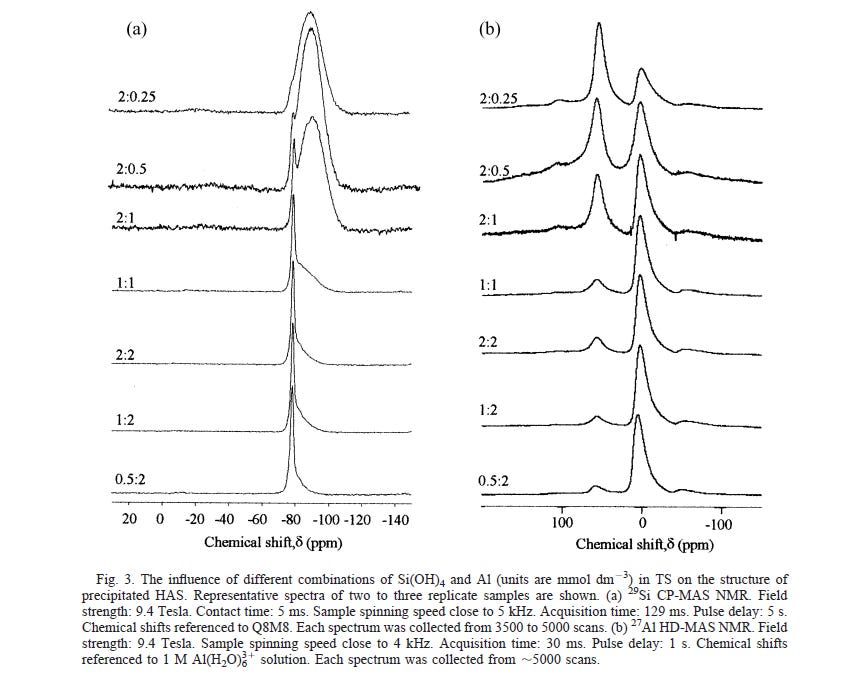
The data obtained for the precipitate we called HASA was largely expected and predictable from previous research carried out by soil scientists investigating ‘mineral’ phases isolated from soil horizons. These soil scientists had identified an aluminosilicate material they called imogolite. This material was composed of one part silicon to two parts aluminium (Si:Al ratio = 0.5) and, critically, the aluminium in this material was of octahedral geometry. This is shown in NMR spectra in part b of the figure for all precipitates collected from solutions where the concentration of aluminium either equalled or exceeded the concentration of silicon (bottom four spectra).
HASA, an imogolite-like material, was the only form of precipitate we expected to find in any of our experimental solutions.
When Fred came and showed me the data that you can see in the upper three spectra in part b of the figure above I was initially incredulous. As were our collaborators from Dow Corning and the University of Nancy, France. Surely, there has been a mistake, perhaps contamination of the precipitates during processing. Subsequent, long and laborious experiments proved that there was no contamination and more importantly they proved the identification of a hither then unknown form of HAS, one we called HASB.
What we discovered was that when the concentration of silicon (as silicic acid) in solution significantly exceeds the concentration of aluminium the form of HAS that is eventually precipitated from solution has a Si:Al ratio of 1.0 and is composed of equal quantities of octahedrally and tetrahedrally coordinated aluminium.
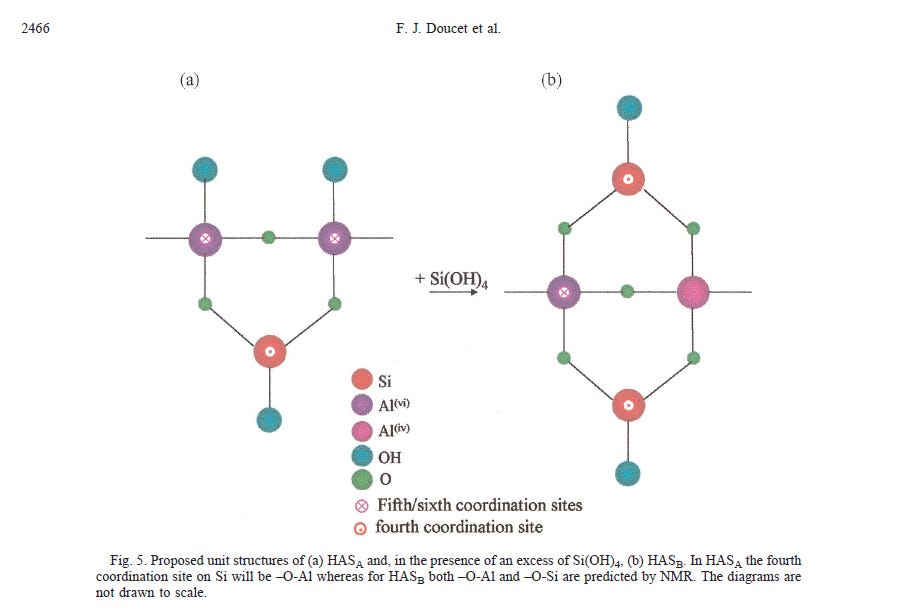
The presence of aluminium with tetrahedral geometry suggested to us that the first product of the reaction of aluminium with silicic acid was HASA and that the further reaction of silicic acid with HASA caused a room temperature de-hydroxylation of half of the octahedrally coordinated aluminium. Thus to accommodate another molecule of silicic acid into the structure of HASB two hydroxyl groups had to leave converting octahedral aluminium to tetrahedral aluminium. All of this fascinating chemistry being catalysed by an excess of the small, neutral silicic acid molecule. For us at least an amazing discovery.
We tried to summarise this reaction in the below figure.
We published this research in the leading geochemistry journal of the time Geochimica Cosmochimica Acta and it is pleasing to know that it is much appreciated by our peers being cited to date over 100 times.
It would be another 15 years before we were able to prove unequivocally the afore suggested mechanism of formation of both HASA and HASB and this will be described in a future discovery post.
Dr. Exley's memoir reminds me of my student days in chemistry and how much work and patience is required of a chemist.
Does this have implications for removal of aluminum from biological tissues?